
 EN
EN
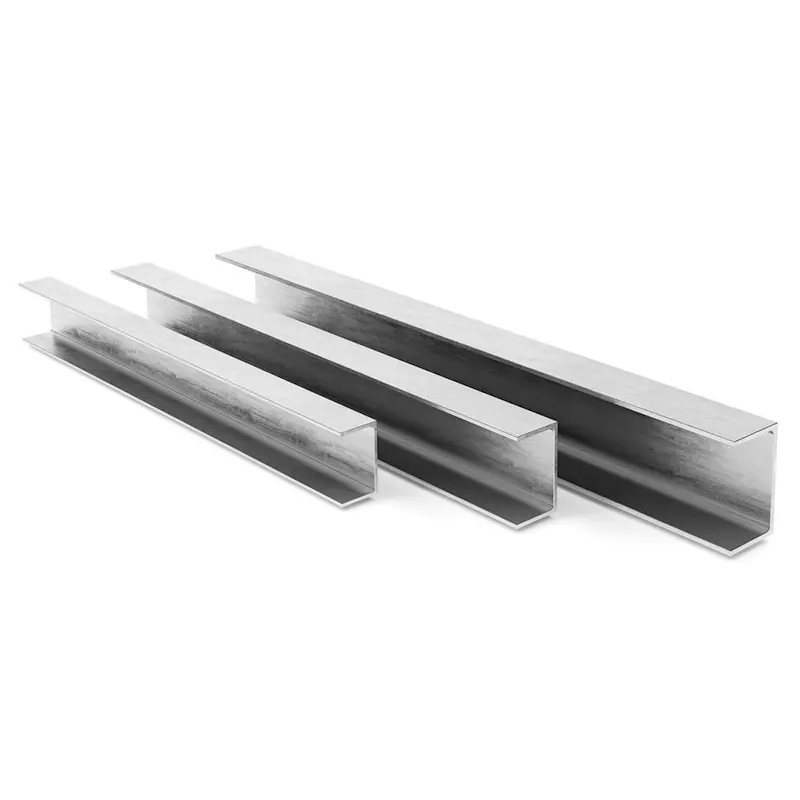
Core Structural Properties of Channel Steel
Yield and Tensile Strength Across ASTM A36, EN S275JR, and SS400 Grades
Yield strength marks the stress threshold at which channel steel begins permanent deformation; tensile strength reflects its maximum load-bearing capacity before fracture. ASTM A36 (U.S.) specifies a minimum yield strength of 36 ksi (250 MPa), making it ideal for general-purpose construction. EN S275JR (Europe) delivers 275 MPa yield strength with mandatory Charpy impact testing at +20°C—ensuring superior toughness in dynamic or seismic loading scenarios. JIS SS400 (Japan) offers 245 MPa yield strength and 400 MPa tensile strength, balancing economy and reliability for non-critical structural uses. In high-seismic zones, EN S275JR’s documented notch toughness provides measurable performance advantages over ASTM A36 and SS400 under cyclic loading.
Moment of Inertia and Section Modulus: Quantifying Bending Resistance in C-Section Geometry
The open C-shape creates inherent directional stiffness: bending resistance is strongest about the major (strong) axis—perpendicular to the flanges—and significantly reduced about the minor (weak) axis. Moment of inertia (I) governs deflection under bending; section modulus (Z) determines how efficiently that resistance translates into allowable stress. For instance:
- Doubling a channel’s depth increases I by a factor of eight, dramatically improving bending capacity
- A 10% increase in flange width enhances torsional rigidity by approximately 22%
This geometric sensitivity explains why a C8×11.5 channel supports up to 30% heavier loads than a C6×8.2 in horizontal, strong-axis applications—without proportional increases in weight or cost.
Weight-to-Strength Ratio: Balancing Density, Dimensions, and Hot-Rolled Channel Steel Efficiency
Hot-rolled channel steel achieves exceptional structural efficiency through its optimized strength-to-weight ratio. Per AISC data, a C4×7.25 channel carries 9.8 tons per pound—more than three times the load-bearing efficiency of an equivalent solid bar. This advantage arises from strategic material distribution: flanges concentrate mass where bending stresses peak, while the web remains thin yet stable under shear. Tight dimensional tolerances (±1/8") further reduce dead weight without sacrificing consistency. As a result, structural frames built with hot-rolled channels weigh up to 18% less than alternatives—lowering both material costs and installation labor.
Directional Behavior and Load-Carrying Limitations of Channel Steel
Web vs. Flange Orientation: How Loading Direction Impacts Bending Capacity and Lateral-Torsional Buckling
Channel steel’s performance is highly orientation-dependent. When loaded perpendicular to the flanges, bending occurs about the strong axis—maximizing moment of inertia and enabling 20–35% higher bending capacity than weak-axis loading. Conversely, loading parallel to the web induces torsion and lateral displacement, triggering lateral-torsional buckling—a failure mode responsible for roughly 17% of collapses in open-section steel members (ASCE Journal of Structural Engineering, 2023). Effective mitigation requires lateral bracing spaced no more than L/3 apart along the compression flange for standard UPE profiles.
Torsional Weakness and When to Choose Box Sections Over Channel Steel
The open C-section geometry fundamentally limits torsional rigidity. Under twisting loads, warping deformations reduce effective shear resistance by up to 40% compared to closed sections like box or tube steel. For applications involving significant rotational forces—such as cantilevered platforms, seismic bracing, or rotating equipment supports—box sections deliver substantially better performance:
| Section Type | Torsional Constant (J) | Typical Warping Resistance |
|---|---|---|
| Channel | 0.05–0.15 cm⁴ | Low |
| Box/Tube | 1.2–8.7 cm⁴ | High |
Engineers should specify box or tubular sections when torsional demand exceeds 15% of total design load—or when unbraced lengths exceed 4 meters. Their closed perimeter eliminates stress concentrations at flange-web junctions, a key vulnerability in channel steel under repeated or seismic loading.
Channel Steel Standards, Types, and Manufacturing Impact on Performance
ASTM A36/A992 vs. EN 10025-2 S275JR: Material Compliance for Global Construction Projects
ASTM A36 and EN S275JR are foundational carbon steel grades—but differ critically in scope and compliance rigor. ASTM A36 prioritizes cost-effective strength (36 ksi min yield, 58–80 ksi tensile) with broad chemical tolerances, supporting widespread use in North American industrial framing. EN S275JR, governed by EN 10025-2, enforces stricter limits on phosphorus and sulfur and mandates Charpy V-notch impact testing (minimum 27 J at +20°C), ensuring verified toughness for infrastructure exposed to variable thermal or dynamic conditions. For global projects, alignment between local code requirements—whether emphasizing ultimate strength (A36) or low-temperature ductility (S275JR)—is essential to avoid specification conflicts during procurement or inspection.
C, MC, and Specialized Channels: Functional Differences in Dimensional Tolerances and Application Scope
Standard C-channels (e.g., ASTM C3×5) feature symmetrical flanges and ±1/8" dimensional tolerance, serving reliably in static building frames and bracing. MC (marine) channels incorporate thicker webs, tighter tolerances (±0.04"), and corrosion-resistant surface treatments—making them preferred for offshore, coastal, or high-humidity environments. Cold-formed channels offer even greater precision (±0.5 mm), supporting mechanical applications like conveyor rails or vibration-sensitive equipment frames. Meanwhile, specialized profiles—including hat sections and tapered channels—optimize stiffness-to-weight ratios or accommodate unique connection geometries. The choice among these types hinges not on nominal size alone, but on functional demands: static load support, environmental resilience, fatigue resistance, or assembly precision.
Real-World Channel Steel Applications in Construction and Mechanical Engineering
Construction Use Cases: Lintels, Balcony Supports, and Bracing Systems Under Code-Mandated Loads
Channel steel excels in architectural and structural roles where efficient load transfer and ease of integration matter. As lintels above doorways and windows, ASTM A36 channels routinely carry distributed loads exceeding 15 kip/ft while limiting deflection to code-specified thresholds. Cantilevered balcony supports rely on strong-axis orientation and high section moduli (up to 10.7 in³) to satisfy IBC live-load requirements of 200 psf. In seismic retrofitting and new-build bracing systems, channels form X- or K-braced configurations that reduce interstory drift by up to 40% versus moment-resisting frames—meeting ASCE 7-22 drift limitations without added column bulk. Their lightweight profile also simplifies installation in constrained urban sites and satisfies IBC wind uplift provisions through robust anchorage detailing.
Mechanical Engineering Applications: Conveyor Rails, Equipment Frames, and Dynamic Piping Supports
In mechanical systems, channel steel delivers predictable performance under repetitive and thermally variable loads. Cold-formed channels serve as conveyor guide rails, maintaining alignment within ±0.1" under 500 kg/m dynamic loads—reducing roller wear by 30% and extending maintenance intervals. Bolted channel assemblies form modular equipment frames capable of isolating resonance in machinery up to 20 HP, thanks to high strong-axis moments of inertia (Ix > 50 in⁴). Galvanized channels function as piping supports across temperature ranges up to 200°F, using slotted connections to accommodate thermal expansion without inducing buckling stresses. The open-web design also facilitates in-service access for inspections and adjustments—while providing torsional rigidity 2.5× greater than comparable angle iron solutions.
Frequently Asked Questions
What is the primary purpose of channel steel?
Channel steel is used primarily for structural applications in construction and mechanical engineering, offering strength and efficiency in load-bearing roles such as braces, supports, and frames.
How does channel steel’s geometry affect its performance?
The C-section shape gives it high bending strength about its strong axis, but limits torsional rigidity. Designs must account for directional stiffness to maximize its load-carrying capabilities.
When should box sections be used instead of channel steel?
Box sections are preferable when torsional loads exceed 15% of total design load or for unbraced lengths exceeding 4 meters, as they provide superior torsional rigidity and resistance to warping.
What are the differences between ASTM A36, EN S275JR, and SS400 steel grades?
ASTM A36 focuses on economical strength, EN S275JR mandates stricter impact and chemical testing for enhanced toughness, and SS400 balances economy and reliability for non-critical uses.
What specialized channel types exist?
Different types include marine channels (MC) for corrosion resistance, cold-formed channels for precision, and hat/tapered channels for specific stiffness-to-weight ratio needs.