
 EN
EN
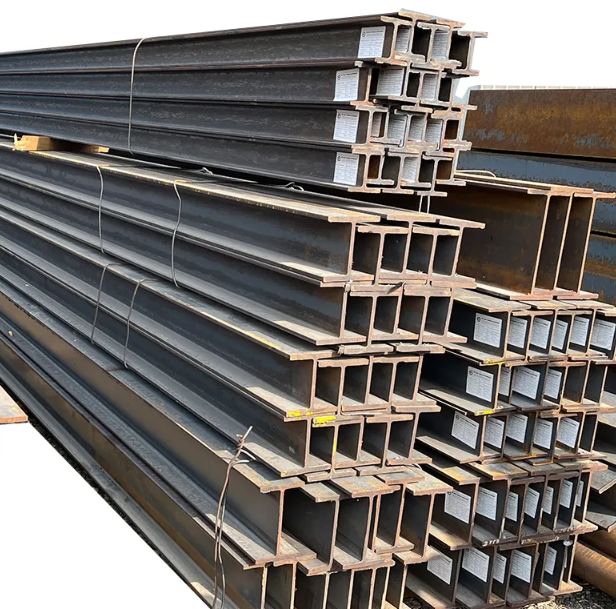
Geometric and Dimensional Differences Between H Beam and I Beam
Flange Width and Parallelism: Why H Beams Have Equal, Parallel Flanges While Traditional I Beams Feature Tapered Flanges
The most striking geometric distinction lies in flange design. H-beams feature uniformly thick, parallel flanges that form a squared-off “H” profile—optimizing load distribution across both axes. In contrast, traditional I-beams have flanges that taper inward toward the web, a legacy design prioritizing weight efficiency over multi-directional stability. This parallel configuration increases surface contact for connections by 18–22% compared to tapered alternatives, per ASTM A6/A6M standards—enhancing weld integrity in heavy-load applications like bridge piers and crane rails. Meanwhile, the tapered flanges of I-beams allow tighter clearance in residential floor systems where lateral forces are minimal and ease of installation is paramount.
Web Thickness and Cross-Section Symmetry: Impact on Fabrication Standards and Axis Alignment
Web thickness directly influences structural resilience and fabrication precision. H-beams consistently incorporate thicker webs—typically 25–40% greater than equivalent I-beams—creating near-symmetrical cross-sections that resist compressive buckling and simplify alignment during erection. This symmetry supports consistent axis orientation, a critical advantage in seismic-resistant framing and modular construction. I-beams, by comparison, use thinner webs to maximize strength-to-weight ratios—ideal for non-load-bearing partitions or long-span roof trusses—but require supplemental bracing to mitigate torsional instability. Industry-standard dimensional comparisons reflect these tradeoffs:
| Characteristic | H-Beam | I-Beam | Performance Implication |
|---|---|---|---|
| Flange Geometry | Parallel, uniform thickness | Tapered, thinner edges | H-beam: +30% lateral load capacity |
| Web Thickness | 30–50 mm (typical range) | 15–30 mm (typical range) | I-beam: ~18% lighter per meter |
| Cross-Section | Near-symmetrical “H” | Asymmetrical “I” | H-beam: Superior bidirectional stability |
Mechanical Performance: How Geometry Drives Load-Bearing Capacity
Bending Strength and Moment of Inertia: Why Wider Flanges in H Beam Enhance Resistance to Bending Moments
Wider, parallel flanges significantly increase an H beam’s moment of inertia—a geometric property measuring resistance to bending. Because bending resistance scales with the square of distance from the neutral axis, placing steel mass farther out (via broad flanges) yields exponential gains. Compared to tapered-flange I-beams of equivalent weight, H beams achieve 15–30% higher moment of inertia—translating directly into reduced deflection under vertical loads. This makes them especially effective in high-moment applications such as bridge girders, high-rise columns, and industrial mezzanine supports where stiffness and serviceability govern design.
Torsional Stiffness and Buckling Resistance: Web-to-Flange Proportions and Their Role in Structural Stability
H beams deliver superior torsional rigidity through balanced web-to-flange proportions. Their thicker webs and uniformly wide flanges create a near-symmetrical section that resists warping under twisting forces—a common failure mode in slender I-beams during seismic events or asymmetric loading. Critically, this geometry also suppresses local buckling: wider flanges lower compressive stress concentrations at edges, while robust webs resist diagonal (shear) buckling. For multi-story buildings in high-wind or seismic zones, this inherent stability enables predictable load paths and simplifies connection detailing—making H beams the preferred choice for primary frames in resilient infrastructure.
Practical Selection Criteria for H Beam and I Beam in Construction Projects
Application Mapping: H Beam for Heavy-Duty Structures (Bridges, High-Rises) vs. I Beam for Lighter Framing (Residential Floors, Mezzanines)
H beams are engineered for maximum structural integrity in demanding applications: bridges, skyscraper cores, heavy industrial platforms, and crane support systems. Their geometry delivers short-span efficiency, high axial capacity, and redundancy under complex loading. I beams, conversely, excel where cost, speed, and adaptability matter most—such as residential floor joists, light commercial roof framing, and mezzanine decking. Their narrower profile and tapered flanges simplify field adjustments and reduce material handling complexity without compromising safety under well-defined, low-lateral-load conditions.
Design Considerations: Connection Simplicity, Weldability, Seismic Resilience, and Cost-Efficiency
Four interrelated factors guide real-world selection:
- Connection simplicity: I beams integrate more readily with standard bolted shear connections due to their narrower flange profiles.
- Weldability: H beams’ uniform flange and web thickness minimizes heat distortion and reduces risk of incomplete fusion—particularly beneficial in full-penetration welds for moment frames.
- Seismic resilience: Per ASCE 7-22 and AISC 341 guidelines, H beams’ symmetrical geometry provides up to 34% greater torsional resistance under lateral forces—critical for ductile frame performance.
- Cost-efficiency: I beams typically use 15–20% less steel per linear meter, offering measurable savings in projects where load demands don’t justify H beam premiums.
In earthquake-prone regions or facilities requiring long-term durability under dynamic loads, H beams are often specified by default—not as over-engineering, but as a calibrated response to code-mandated performance thresholds. In low-risk, budget-sensitive builds—especially those with repetitive, standardized framing—I beams remain the pragmatic, code-compliant standard.
FAQs
What is the main difference between H beams and I beams?
H beams feature parallel flanges and thicker webs, which enhance load-bearing capacity and bidirectional stability, while I beams have tapered flanges, making them lighter and suitable for simpler applications.
Why are H beams preferred for seismic-resistant structures?
H beams’ symmetrical cross-section and thicker web-to-flange ratio provide increased torsional rigidity and suppress buckling, meeting seismic resilience guidelines effectively.
Which beam type is more cost-effective?
I beams are typically more affordable due to their reduced material use, making them ideal for applications with moderate load requirements and budget constraints.
When should I use an H beam?
H beams are best used in scenarios requiring high structural integrity, such as bridges, high-rises, and other heavy-duty structures that deal with significant loads and stresses.